GETTING STARTED · A2A
Ask another agent.
Follow the task.
Explore Agent2Agent collaboration across platforms. Learn discovery, Agent Cards, access checks, and the difference between accepting a request and completing it.
Chapter 1
Delegate a bounded task
Agent2Agent, or A2A, standardizes how agents describe themselves and exchange requests, messages and task results. Oracle documents collaboration between published Fusion agents and agents on other platforms.
Our fictional partner agent investigates delivery alternatives. Sam supplies the objective, relevant approved details, and a read-only boundary. The partner remains responsible for its own implementation and authorized access.
Oracle references: A2A collaboration
Chapter 2
Find out what the agent offers
An Agent Card is a machine-readable description of an agent: what it does, how to call it, and its authentication requirements. A catalog or registry helps discover candidate agents.
Finding a candidate is only the beginning. Check that its skills, interface and version match the request. Discovery does not mean the caller may execute every advertised operation.
Explore the parts
Discovery
A catalog or registry helps locate agents and their descriptions.
The caller finds a delivery-planning specialist.
Oracle references: A2A components · A2A authentication and access
Chapter 4
Choose the direction of collaboration
An external client can call an authorized, published Fusion workflow-backed agent through Fusion’s A2A surface. In the other direction, a Fusion workflow can use a configured external A2A agent.
These directions have different setup and authentication details. Keep the caller, target service and identity explicit instead of assuming one connection configuration works both ways.
A small challenge
Sam’s Fusion workflow will ask a partner-hosted agent to investigate deliveries. Which direction is this?
Choose an answer to explore the reasoning. You can try again.
Oracle references: A2A collaboration · External A2A agents
Chapter 5
Follow the task to a result
A request may lead to a task that takes time. An acknowledgement or task identifier is not the completed delivery plan. Follow the documented status or streaming interaction and inspect the eventual result.
In our example, the partner first accepts the investigation, then returns two options with supporting information. Sam still reviews the dates, evidence and unresolved gaps before choosing what to do.
A small challenge
The partner returns a task identifier and says the investigation was accepted. Is the plan complete?
Choose an answer to explore the reasoning. You can try again.
Oracle references: A2A collaboration · A2A components
Chapter 6
Understand the Fusion connection
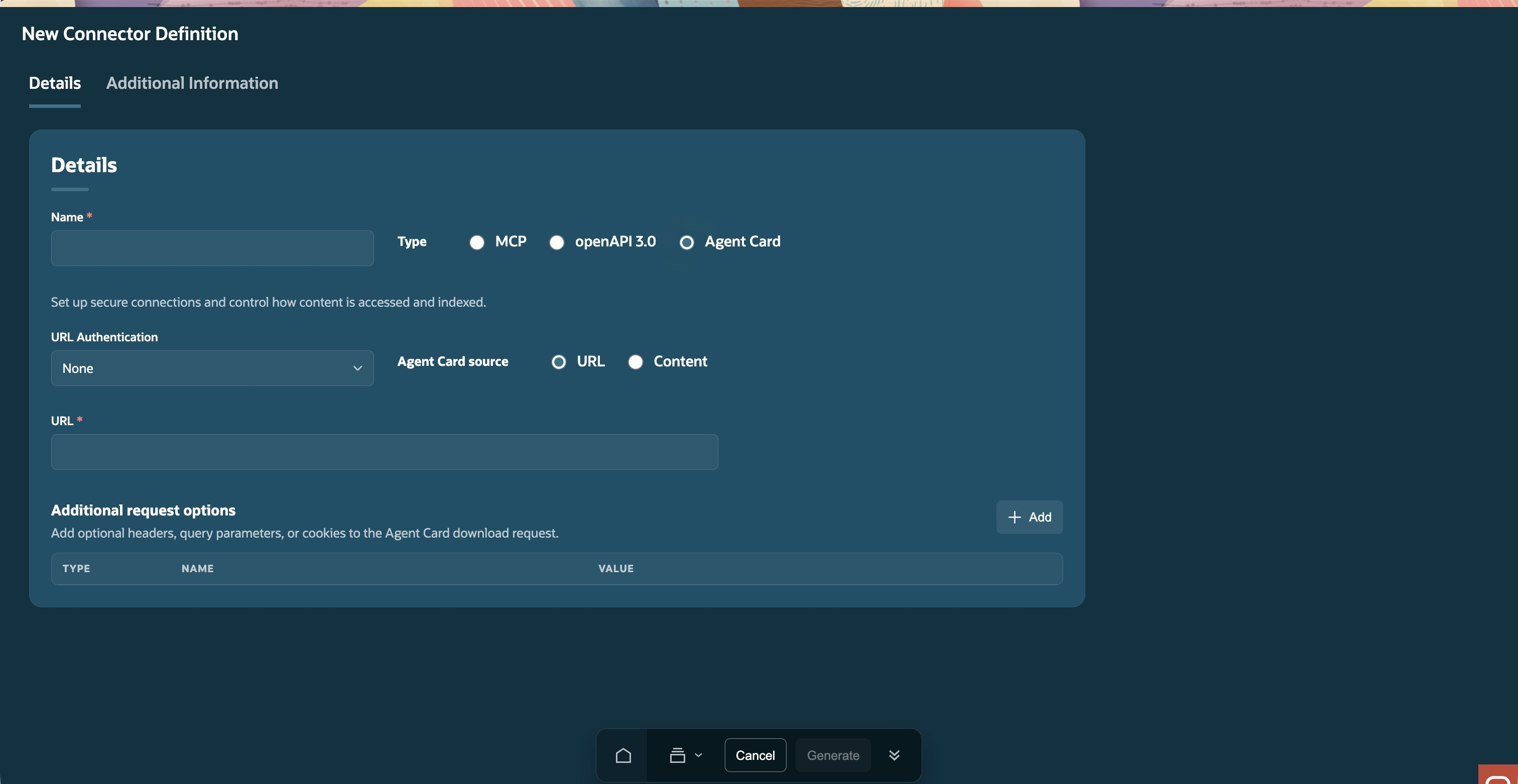
For an external A2A agent, the 26D guide describes generating a connector definition from its Agent Card, creating a connector instance with the target URL and authentication, and adding a Connector tool for use in the workflow.
For inbound calls to Fusion A2A, the caller must authenticate. Execution authorization and user-scoped status access still apply after discovery. Follow the official direction-specific instructions for the chosen integration.
Oracle references: External A2A agents · A2A authentication and access
Chapter 7
Review the result and the boundary
Test a permitted task, an unauthorized request, an unavailable agent and an incomplete task. Decide how the caller reports missing evidence and how a person can take over.
If a write request times out, do not assume nothing happened and repeat it blindly. Confirm the operation’s status and supported recovery behavior. Sam’s first version requests a plan only; booking remains a separate authorized decision.
Oracle references: A2A authentication and access · Evaluation scenarios
TAKE IT WITH YOU
You have a starting point.
- Explain an Agent Card, discovery and a task-oriented A2A interaction.
- Distinguish external-to-Fusion calls from Fusion-to-external collaboration.
- Separate request acceptance, execution permission and verified task completion.
Read further with Oracle
Concepts are summarized in plain language. Product availability and setup can vary by release and configuration.
When you are ready to build and test
Continue into the official learning paths when you want hands-on product setup.
Original learning stories & interactive examples © 2026 Sourabh Biharia.
Need a quick definition? Open the glossary