GETTING STARTED · FUSION CLAW
Start with the outcome.
Keep the boundaries.
Explore how Fusion Claw helps agentic applications plan and carry out complex work, with people defining the limits.
Chapter 1
Recognize a job that needs a plan
Some requests are simple lookups. Others need investigation, comparison, several steps, and adjustments as conditions change.
Fusion Claw is a governed execution runtime for Fusion Agentic Applications. It combines AI reasoning with enterprise computation and authorized actions to work toward a business outcome.
Our fictional readiness-planning example is a way to understand those concepts. It is not a claim that this exact application is delivered by Oracle.
Oracle references: Fusion Claw
Chapter 2
Give the outcome its building blocks
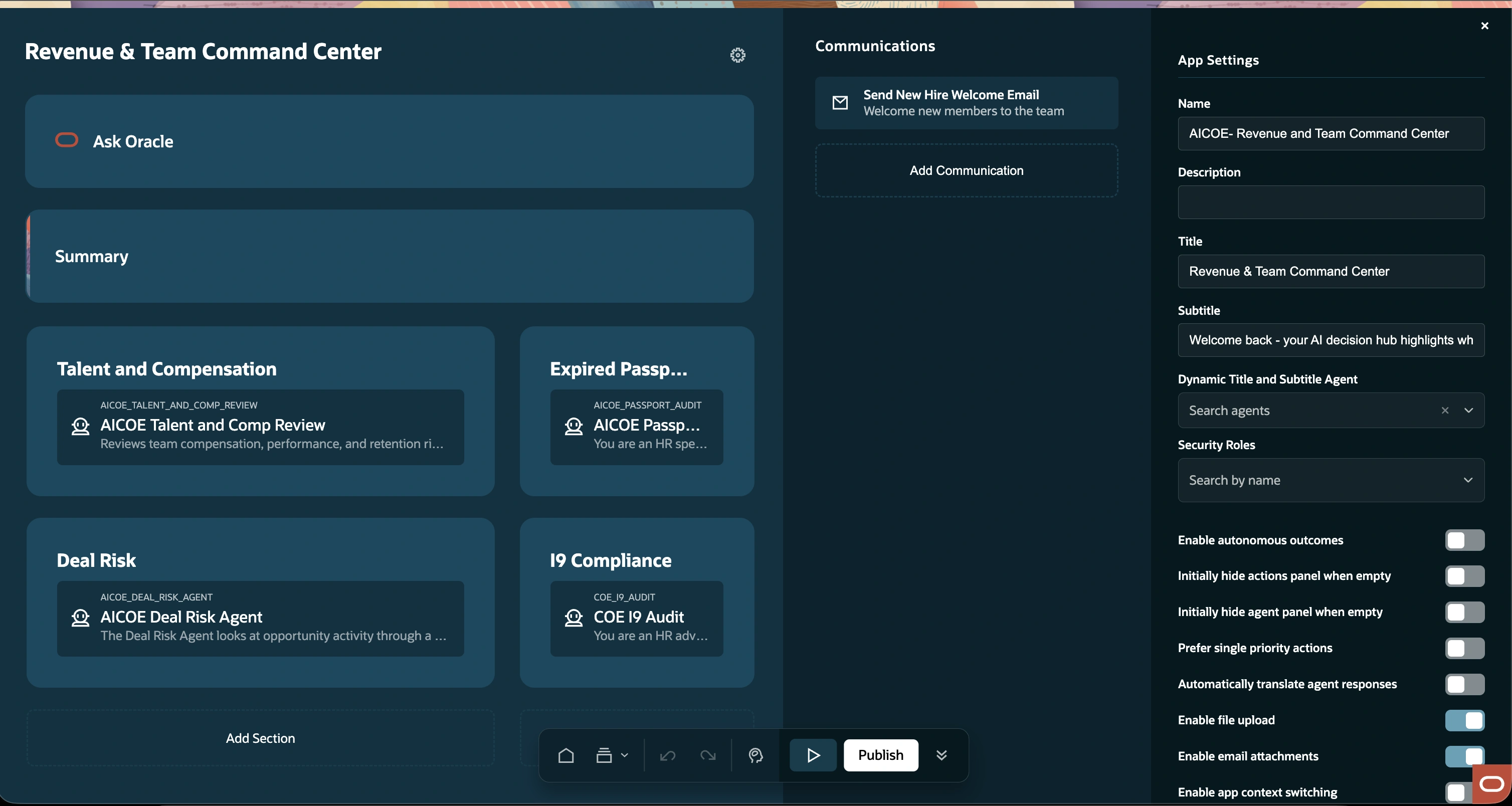
A designer configures what the application should achieve, the guidance it follows, the capabilities it can use, and its operating defaults.
Skills describe how to do a kind of work. Capabilities expose specific operations, such as reading inventory or reserving equipment. Guidance about a task does not itself grant permission to change records.
Explore the parts
Goals
Describe the business outcomes the application is intended to support.
Prepare equipment readiness and identify gaps before each start date.
Try it: turn a request into an outcome
Start with “Help with onboarding.” Reveal the missing pieces to make the result clear.
1. Name the people and the result
Who is this for, and what counts as done?
Prepare an equipment-readiness plan for the four teammates starting next Monday. Identify who can receive a laptop and who still needs an alternative.
2. Name the evidence
What should support the result?
Use authorized start dates and current inventory. Include the information used and explain missing or conflicting records. Do not invent availability.
3. Bound the actions
What may happen next?
For this first version, prepare recommendations for Sam’s review; do not reserve or purchase equipment. Configure capabilities, permissions, policies, and approvals to support those limits. Writing a limit in the goal does not replace those controls.
Fictional learning example. Read the Oracle guidance
Oracle references: Configure autonomous outcomes
Chapter 3
Follow a plan through a change
AI reasoning helps interpret the objective and consider alternatives. Computation handles tasks such as calculations and comparisons. The configured capabilities determine what can be read or changed.
Explore the small example below. Change the delivery situation and the allowed authority, then step through the outcome. Notice that a request to act cannot create a missing permission.
Explore a bounded outcome
Equipment readiness for four new starters
Prepare first-day equipment readiness and explain unresolved gaps.
Available reads: start dates and inventory. Purchases are outside this example’s capabilities.- Understand
- Gather evidence
- Compare options
- Check authority
- Return result
Understand the objective
Identify the result Sam needs and the boundaries that apply.
Example outcome receipt
Oracle references: Fusion Claw · Configure autonomous outcomes
Chapter 4
Read the evidence with the result
An outcome receipt records the evidence, decisions, authority, and actions associated with the work. It helps a business owner understand the result and its consequences.
The example receipt above follows the scenario you selected. Read its sources and action status, including cases where no change was authorized.
For a real outcome, review the applicable policies, evidence, approvals, and affected transactions. A useful result should be understandable to the person accountable for it.
Oracle references: CoE: Outcome receipts
Chapter 5
Choose the approach that fits
Fusion Claw is useful for complex work that needs planning and evidence across several steps. A direct lookup or a straightforward fixed process can use a simpler approach.
The goal is a useful business outcome, with an approach proportionate to the task. Start with a clear owner and a scope you can evaluate.
Choose the approach
What kind of work is this?
Choose an approach and explore why it fits.
Oracle references: CoE: Choosing Claw use cases
Chapter 6
Begin with a bounded outcome
Choose a recurring task with a clear result. Identify the information it needs, the permitted capabilities, and the points where a person should decide.
Start by reviewing recommendations and receipts. Expand the authorized actions only after the business is satisfied with the behavior and its controls.
You now have the foundations for exploring Oracle’s delivered applications and official labs. Use the references below to connect this conceptual example to the product capabilities available in your release.
A small challenge
A plan proposes reserving equipment, but the application has no reservation permission. What happens?
Choose an answer to explore the reasoning. You can try again.
Oracle references: Configure autonomous outcomes · CoE: Choosing Claw use cases
TAKE IT WITH YOU
You have a starting point.
- Distinguish an outcome, a skill, and a capability.
- Explain why planning and authority are separate.
- Read an outcome receipt and recognize when a simpler approach fits.
Read further with Oracle
Concepts are summarized in plain language. Product availability and setup can vary by release and configuration.
When you are ready to build and test
Continue into the official learning paths when you want hands-on product setup.
Original learning stories & interactive examples © 2026 Sourabh Biharia.
Need a quick definition? Open the glossary