GETTING STARTED · KNOWLEDGE, DOCUMENTS & TOOLS
Find the evidence.
Choose the right path.
Learn when to use reusable documents, business records, chat attachments, and structured extraction. Follow the information from source to answer.
Chapter 1
Ask what information the task needs
The model is not the current policy or inventory system. Decide which source is authoritative for the question, whether it is current, and whether the caller may use it.
Alex’s policy question needs approved reference material. Available stock needs a current authorized record. The uploaded request needs its contents read, while a repeatable intake process may need specific fields extracted.
Oracle references: Document Tool · Tool nodes
Chapter 2
Choose the information path
Choose a path for the job instead of putting every file into one large knowledge collection. A one-time conversation attachment and reusable reference knowledge serve different needs.
Explore the four situations. The equipment examples are fictional; a real build must use supported business objects and verified tool contracts.
Explore the parts
Reusable policy
Use processed reference content that the agent can retrieve for repeated questions.
Alex asks which equipment the current policy allows.
Oracle references: File-processing choices · Tool nodes
Chapter 3
Make reusable knowledge ready
The Document Tool lets an agent use uploaded reference content. In the documented flow, Ready to Publish starts document processing; the content becomes Published after that process completes.
Prepare focused, readable documents with meaningful headings. Remove obsolete or duplicated content. Keep an owner and review date so a policy update can lead to a deliberate content refresh.
Oracle references: Document Tool · Prepare documents
Chapter 4
Read the retrieval evidence
Retrieval-augmented generation, or RAG, brings relevant source content into the answer-generation process. Finding a passage and explaining it correctly are separate things to check.
Suppose an older policy allows a different laptop allowance. A fluent answer based on that passage can still be wrong for today. Inspect the source, effective date, relevant context, and answer; a citation alone does not settle the question.
A small challenge
The helper cited a policy, but it is last year’s version. What should Sam check first?
Choose an answer to explore the reasoning. You can try again.
Oracle references: Evaluation scenarios · Prepare documents
Chapter 5
Recognize an unanswerable question
Sometimes the available sources do not contain the answer. The helper should explain the gap instead of filling it with a guess. If the question is unclear, ask for the detail needed to continue.
Suppose Alex asks about a policy for a country missing from the approved collection. A useful response identifies the missing coverage and points Alex toward the policy owner.
Oracle references: Evaluation scenarios
Chapter 6
Extract fields, then validate them
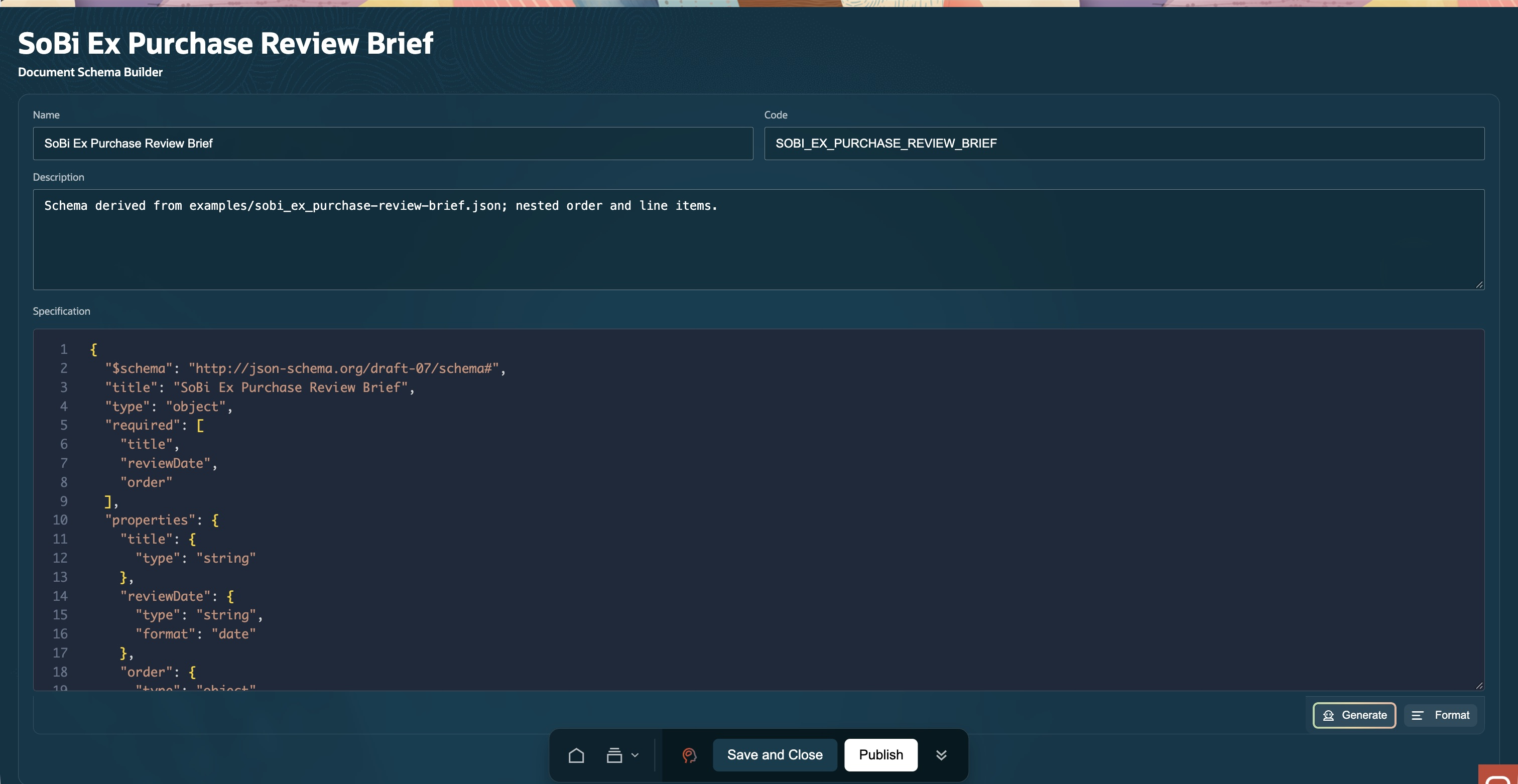
For structured extraction, a Document Schema defines the fields a Document Processor should return. Review the generated schema before publishing it and using it in a workflow.
In our example, equipment type and needed-by date are extracted from a request. Check missing fields and ambiguous dates before using them in a decision. A structured result is easier to process, but its values still need validation.
A small challenge
An extracted needed-by date is missing. What is a useful next step?
Choose an answer to explore the reasoning. You can try again.
Oracle references: Document schemas
Chapter 7
Start with a small source set
Begin with a few approved documents and realistic questions, including one the sources cannot answer. Test readable text, a table, missing information, and an outdated source.
Use Oracle’s current file-handling guidance for the chosen path. A file’s size alone does not establish that it will process reliably; dense text, images, scans and structure also matter. Split large or mixed-purpose content when needed.
Oracle references: File-processing choices · Evaluation scenarios
TAKE IT WITH YOU
You have a starting point.
- Choose between reference retrieval, business-record lookup, chat files, and structured extraction.
- Separate ingestion, retrieval, access, and answer-quality problems.
- Review freshness, source evidence, missing fields, and unsupported questions.
Read further with Oracle
Concepts are summarized in plain language. Product availability and setup can vary by release and configuration.
When you are ready to build and test
Continue into the official learning paths when you want hands-on product setup.
Original learning stories & interactive examples © 2026 Sourabh Biharia.
Need a quick definition? Open the glossary