GETTING STARTED · MONITORING & EVALUATION
Watch the work.
Check the outcome.
Learn what production signals, evaluation results, and execution traces can tell you. Connect a reported problem to a useful test and a reviewed improvement.
Chapter 1
Ask what good means
Start with the business promise. For Alex’s question, a useful answer should use the current policy, respect access, explain missing information and arrive within a practical time.
A run can end without an error and still miss that promise. Review what happened in the process and what the person actually received.
Oracle references: Evaluation scenarios · Monitoring and evaluation
Chapter 2
Meet the evidence
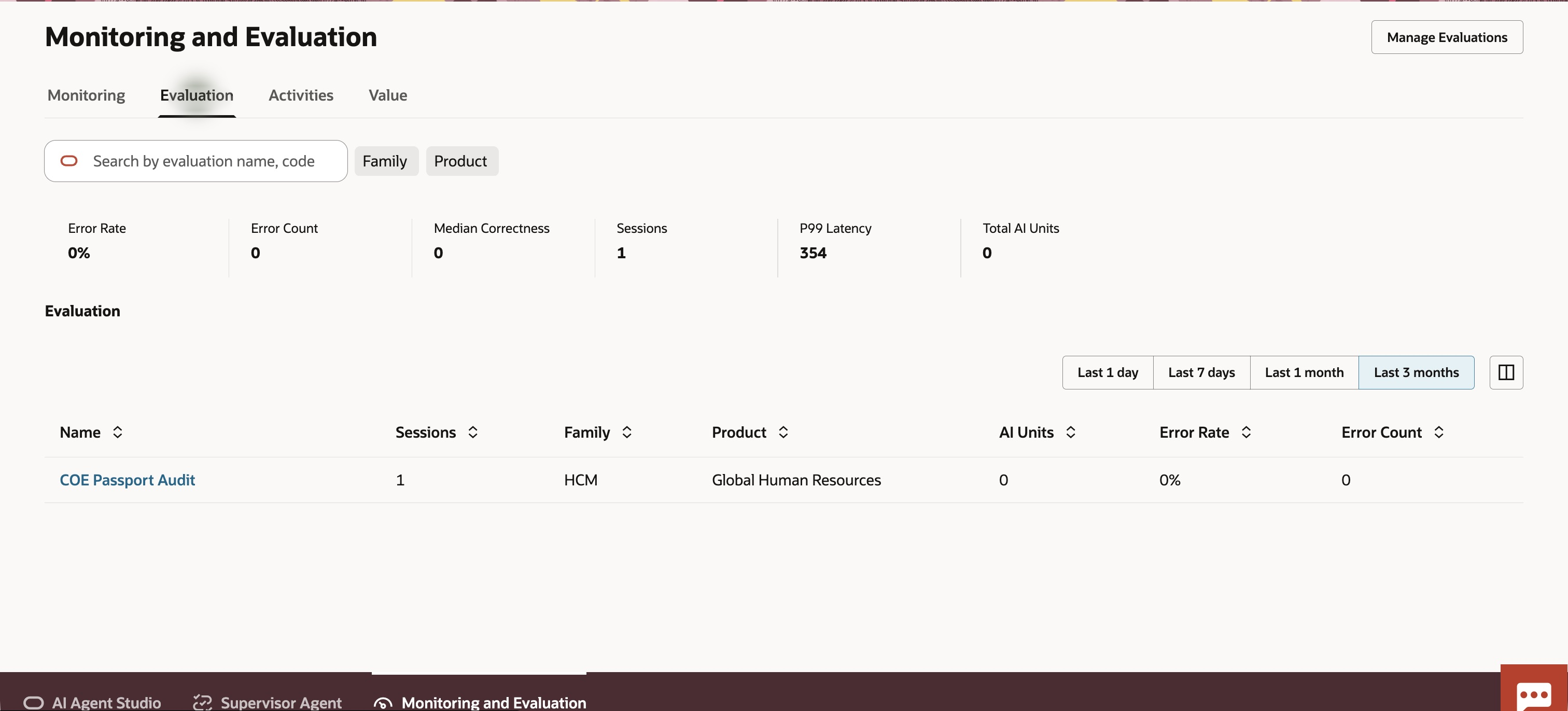
Monitoring observes deployed usage and execution behavior. Evaluation checks responses against a prepared set of questions and expected answers. Traces help inspect the steps behind a result.
ATLAS adds repeatable scenario and route tests to the development lifecycle. It complements the built-in Monitoring and Evaluation experience, often called METRO. Use each for the evidence it can provide.
Explore the parts
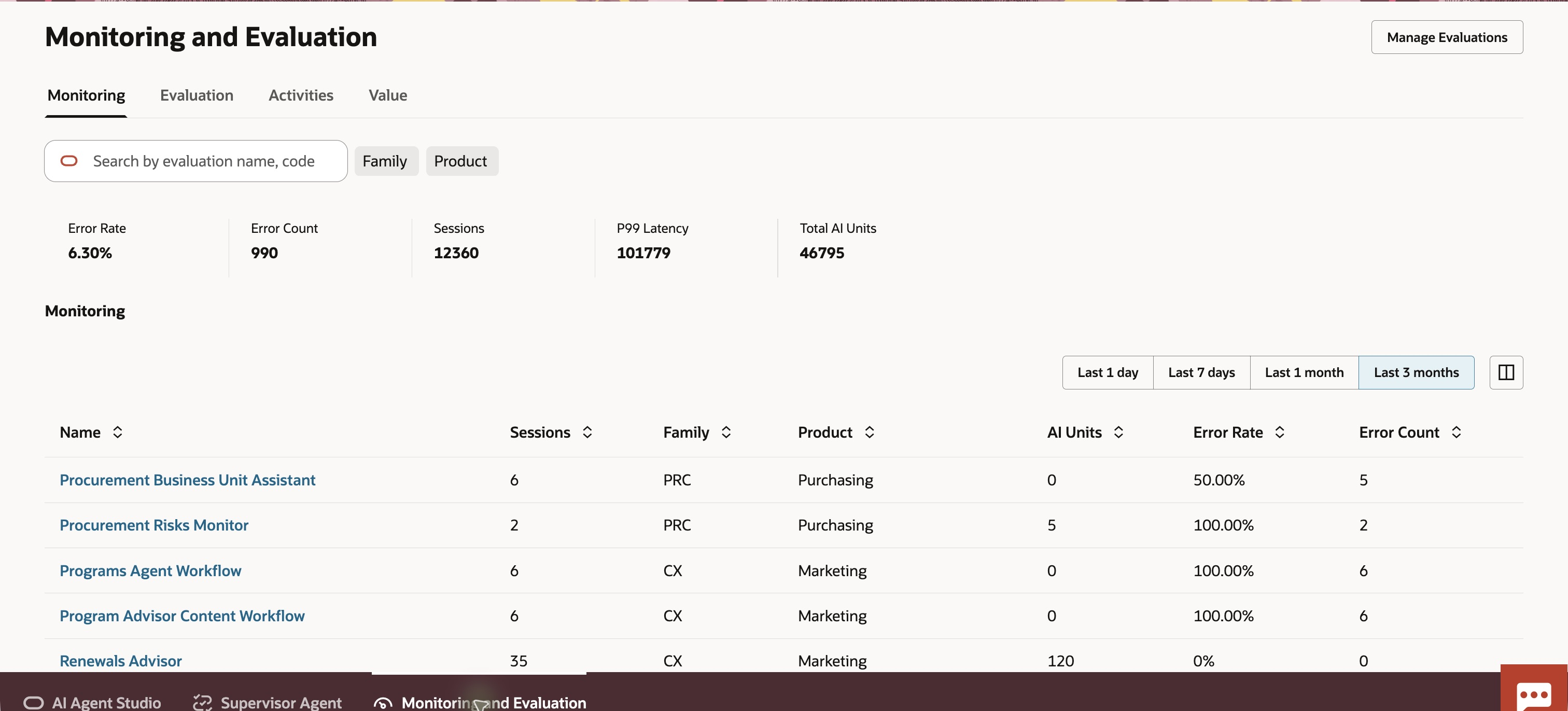
Monitoring
Review usage, errors, response times and consumption over the selected period. Check metric freshness.
Sam sees that some equipment questions take much longer than others.
Oracle references: Monitoring and evaluation · CoE: ATLAS and METRO
Chapter 3
Read a signal in context
Error rates, session counts, response times, tokens and AI units answer different operating questions. Compare a signal with the task, version and time period instead of treating one number as the whole story.
The documented metric table distinguishes production monitoring from evaluation measures such as correctness and RAG quality. Aggregated dashboards need the Aggregate AI Agent Usage and Metrics process; check freshness before drawing conclusions.
A small challenge
The run ended without an error but answered from an old policy. What is the useful interpretation?
Choose an answer to explore the reasoning. You can try again.
Oracle references: Monitoring and evaluation
Chapter 4
Prepare questions worth checking
An evaluation set pairs questions with expected responses and selected metrics. Ask the subject-matter expert to review the expected answer against current sources. Include ordinary questions, ambiguity, unsupported requests and relevant follow-up turns.
Choose the intended agent version and appropriate run mode. Compare actual and expected responses, inspect the trace, and review human feedback as well as model-generated scores. Set thresholds for the business requirement rather than copying an arbitrary number.
A small challenge
Which is a useful evaluation question for the equipment helper?
Choose an answer to explore the reasoning. You can try again.
Oracle references: Evaluate agents · Evaluation scenarios
Chapter 5
Compare before and after
Oracle lets you compare two runs of the same evaluation, both in summary and question by question. Look at the answers alongside correctness, response time and token usage.
Sam reruns the same policy questions after updating the source. A faster answer is useful only if it still meets the expected behavior. Note what changed between runs so the comparison has context.
Oracle references: Compare evaluation runs
Chapter 6
Turn a finding into a test
Sam identifies that an obsolete policy was retrieved. The improvement may be a source update or retrieval change; rewriting the final prompt alone may not fix it.
Add a scenario that exposes the problem, apply the reviewed change, and rerun the relevant tests and evaluations. Keep the ordinary successful route covered too. Watch the deployed version afterward to see whether the issue recurs.
Oracle references: CoE: ATLAS and METRO · Evaluation scenarios
Chapter 7
Start a small review habit
Choose an owner and a small set of meaningful checks. Review failed sessions, slow cases, unsupported answers and unexpected consumption with the appropriate permissions.
Keep the agent version, source changes, evaluation results and business feedback together. Estimated savings in a dashboard are not a substitute for checking actual effort and outcomes. Expand the review as real usage reveals new cases.
Oracle references: Monitoring and evaluation · Value estimates
TAKE IT WITH YOU
You have a starting point.
- Distinguish monitoring, evaluation, tracing and ATLAS regression tests.
- Interpret execution metrics alongside answer evidence and business completion.
- Turn an observed problem into a reviewed change and repeatable test.
Read further with Oracle
Concepts are summarized in plain language. Product availability and setup can vary by release and configuration.
When you are ready to build and test
Continue into the official learning paths when you want hands-on product setup.
Original learning stories & interactive examples © 2026 Sourabh Biharia.
Need a quick definition? Open the glossary