LEARNING / PRACTICAL COLLECTIONS
Map identity, access and the data boundary
A builder can edit a workflow and still lack permission to read its data. Trace who configures, who executes and whose authorization protects each source. Approval is another boundary, not a shortcut around access.
Fictional learning examples, based on public 26D references. These exercises run in your browser and do not connect to Fusion. The configuration checkpoints are planning guidance, not a verified end-to-end Fusion lab.
The seven release gates are an authored engineering checklist. They are not an Oracle-mandated approval process or a production-readiness certification.
D02 / 26D REFERENCE
What you’ll take away
Produce a reviewable release decision, not a checked box.
8-12 min reading; project work varies · Time estimate, excluding access and setup.
Start with: Define success before adding a release button.
A WORKED DECISION
The Starter Ready example
The inventory lookup uses a test connection approved for read-only sample data. Sam’s review does not grant Alex access to a restricted source.
Evidence to collect
- Identity-to-resource matrix
- Permission approval reference
- Sanitized permitted/denied execution evidence
Are access decisions correct at the actual source, for each execution mode?
MAKE THE CALL
What would you do?
The builder can read inventory, but a permitted pilot user is denied.
Choose an option to explore the result.
Read the recommended decision
Hold this release. Repair and retest the intended authorization boundary; do not replace it with builder access.
RECOGNIZE THE CONTROLS
Inside AI Agent Studio
Actual UI controls from other example artifacts. These images do not show the fictional Starter Ready build running. Visible configuration is not execution evidence; labels and availability vary by release and permissions.
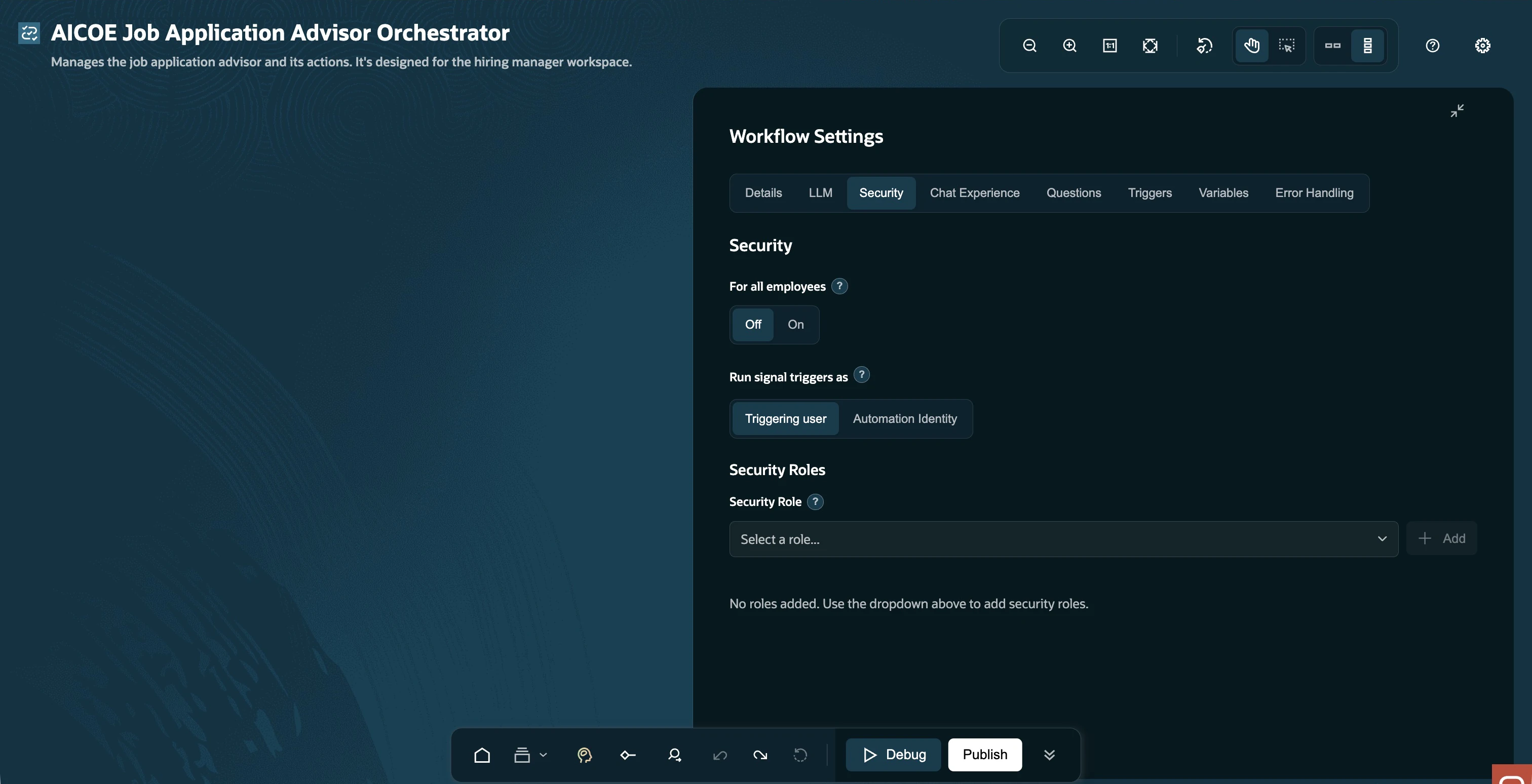
Review workflow security
 Enlarge screenshot
Workflow Security shows employee access, signal-trigger identity and role controls. These settings do not establish authorization at an underlying business-data source.
Look for: Keep workflow run access separate from source permissions and review the identity used by each execution mode.
FOLLOW THROUGH
Put the reasoning into practice
- List every data source and connection owner.
- Record builder, runtime and underlying source identities without recording secret values.
- Review least-privilege access with the pillar/source owner.
- Test a permitted and denied user separately, including background or triggered execution where relevant.
Expected outcome
A named reviewer records pass, hold or a documented exception with scope and expiry. A demo success alone is not a release decision.
CHECK YOUR WORK
What needs to hold true?
Use this checklist for your own review. It is not an automated test result.
READ THE SOURCE
Official references
Product facts come from public Oracle sources. Sample rules, data, tests and experiments are original teaching examples.
- Identity and security Oracle Fusion CoE · 2026-07-27
- Connector access setup Oracle Fusion CoE · 2026-11-10