LEARNING / PRACTICAL COLLECTIONS
Operate, improve and eventually retire
Publication starts the operating phase. Someone must own failures, consumption, source changes and future releases. A small review rhythm is more useful than a dashboard no one checks.
Fictional learning examples, based on public 26D references. These exercises run in your browser and do not connect to Fusion. The configuration checkpoints are planning guidance, not a verified end-to-end Fusion lab.
The seven release gates are an authored engineering checklist. They are not an Oracle-mandated approval process or a production-readiness certification.
D07 / 26D REFERENCE
What you’ll take away
Produce a reviewable release decision, not a checked box.
8-12 min reading; project work varies · Time estimate, excluding access and setup.
Start with: Pilot with a recovery route.
A WORKED DECISION
The Starter Ready example
For this community example, propose a weekly manual review of unsupported questions and recurring lookup failures. A release change calls for targeted regression tests and source-reference review. This is an authored operating practice; no schedule or alert is created.
Evidence to collect
- Operating runbook
- Reviewed indicators and thresholds
- Incident/change log
- Next review owner
- Retirement checklist
Is there a named person who can explain current behavior, act on failures and safely end the service?
MAKE THE CALL
What would you do?
The service has a named owner, reviewed indicators and a documented escalation route, with no blocking defects.
Choose an option to explore the result.
Read the recommended decision
Proceed within the approved scope. Proceed within the approved scope, retain the evidence and use the agreed review rhythm; this is not a universal production guarantee.
RECOGNIZE THE CONTROLS
Inside AI Agent Studio
Actual UI controls from other example artifacts. These images do not show the fictional Starter Ready build running. Visible configuration is not execution evidence; labels and availability vary by release and permissions.
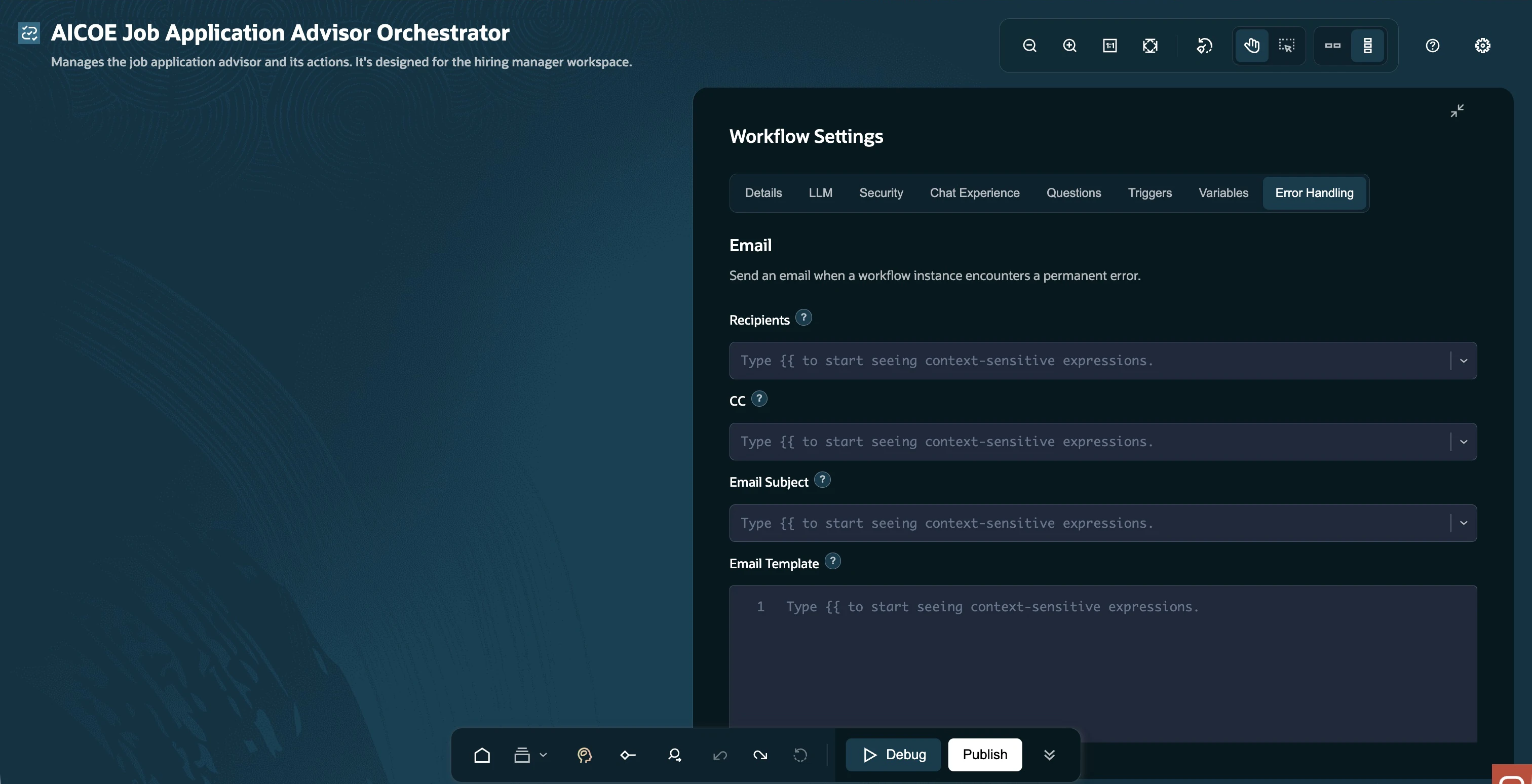
Find failure-notification settings
 Enlarge screenshot
The Error Handling tab exposes email settings for a workflow instance that encounters a permanent error. The fields are empty; no delivered notification is shown.
Look for: Locate recipients, CC, subject and template. Verify notification delivery separately from setting up the fields.
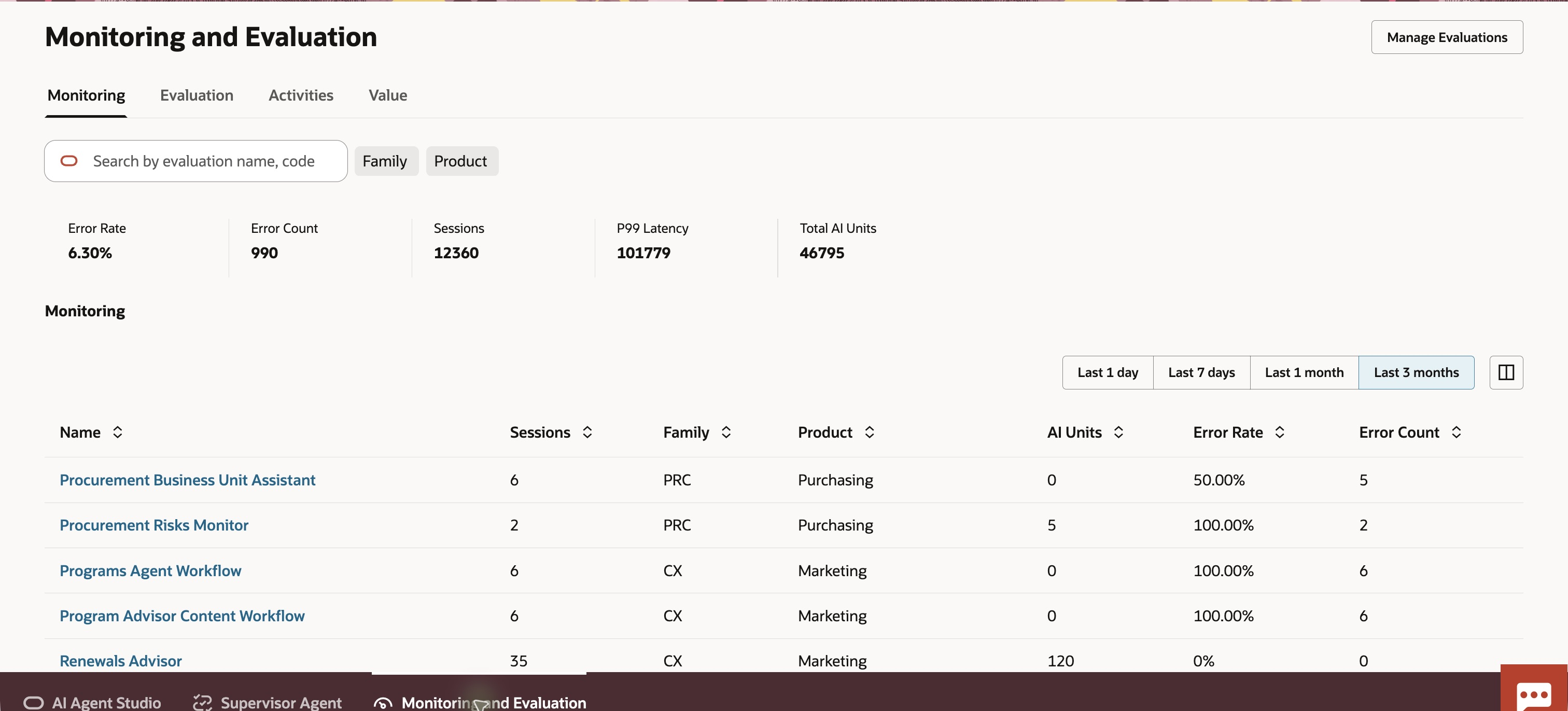
Find monitoring summaries
 Enlarge screenshot
Monitoring displays activity and consumption summaries. These captured figures are not before-and-after measurements for our experiments.
Look for: Compare the same workload and include failures; do not infer a performance gain from this screenshot.
FOLLOW THROUGH
Put the reasoning into practice
- Assign operational ownership, coverage and escalation.
- Track quality, failed requests, latency and consumption against the intended outcome.
- Review budgets and metering behavior with the authorized owner.
- Revalidate on source/model/release changes and retain a supported recovery option.
- Define retirement: remove entry points, review dependent artifacts, revoke unused access through owners and apply retention policy.
Expected outcome
A named reviewer records pass, hold or a documented exception with scope and expiry. A demo success alone is not a release decision.
CHECK YOUR WORK
What needs to hold true?
Use this checklist for your own review. It is not an automated test result.
READ THE SOURCE
Official references
Product facts come from public Oracle sources. Sample rules, data, tests and experiments are original teaching examples.
- AI Unit Budgeting overview Ch. 11 · Release 26D
Metering can lag. Do not promise exact immediate zero-overrun behavior.
- Compare Evaluation Runs Ch. 12 · Release 26D
- ATLAS final readiness Ch. 16 · Release 26D